By Audrey Hayes
Updated November 2026
A sleeping pad repair kit is one of the cheapest insurance policies a camper can carry. A small puncture on an air pad can leave you sleeping on cold ground after the first night, and a well-chosen patch set can fix it in a few minutes at the campsite. This list compares three patch options based on the criteria that matter most: the material the patch bonds to, whether it needs glue or heat, the range of hole sizes it covers, and how well it suits a pad you may be fixing on a trail. The three picks below cover a broad repair kit, a set of clear peel-and-stick patches, and a general-purpose tape assortment for multi-gear use.
Our top picks at a glance
- 1
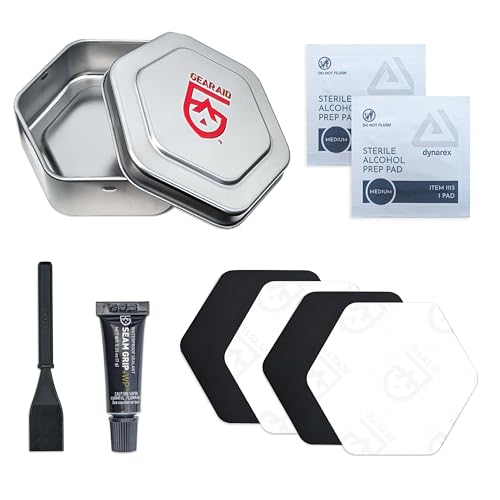 TOP CHOICEBest overallGEAR AID Seam Grip WP Camp & Trail Repair KitView on Amazon
- 2
 Best for clear, low-profile patchesIgneous Airlock Inflatable Sleeping Pad Repair PatchesView on Amazon
- 3
 Best for mixed gear repairsGEAR AID Tenacious Tape Repair PatchesView on Amazon
Our Top Picks
| Product | Best for | Key feature |
|---|---|---|
| GEAR AID Seam Grip WP Camp & Trail Repair Kit | Campers who want a sealant option for holes and seams | Waterproof sealant with four Tenacious Tape hex patches |
| Igneous Airlock Inflatable Sleeping Pad Repair Patches | Air pad owners who want no glue or heat | Eight clear TPU peel-and-stick patches |
| GEAR AID Tenacious Tape Repair Patches | Repairing several types of outdoor gear | 19 patch sizes in nylon tape |
GEAR AID Seam Grip WP Camp & Trail Repair Kit
GEAR AID Seam Grip WP Camp & Trail Repair Kit – Waterproof 0.25 oz Sealant with Four Tenacious Tape Hex Patches (2.5", Black and Clear) for Fixing Holes, Seams on Tents, Sleeping Pads and Outdoor Gear
Best for: Campers who want a sealant option for holes and seams
This kit suits people who expect to repair more than one item and want a sealant for seams as well as punctures. It is a good fit for owners of tents, sleeping pads and other outdoor gear who would rather keep one kit in the pack than several separate products.
Key specs
- Waterproof seam sealant, 0.25 oz
- Four Tenacious Tape hex patches, 2.5 inches
- Black and clear patch colors
Pros
- Covers both punctures and seam leaks
- Patches come in a size useful for medium-sized pad holes
- Works across tents, pads and other gear
Cons
- A small sealant tube may run out after a few repairs
- Sealant needs adequate cure time before the pad is used again
Bottom line: Pick this if you want one versatile kit that handles seams as well as holes, and you are comfortable waiting for sealant to cure.
View on AmazonIgneous Airlock Inflatable Sleeping Pad Repair Patches
Igneous Airlock Inflatable Sleeping Pad Repair Patches, Clear TPU, 8 Pack | Peel-and-Stick Puncture Fix for Camping Pillows, Water Bladders, Reservoirs and Packrafts, No Glue or Heat, 1.4 x 1.1 in
Best for: Air pad owners who want no glue or heat
These patches are aimed at air pad users who want a fast, low-profile fix. The clear TPU material is designed to bond to inflatable fabrics without adhesive mess or a heat source, which makes them practical at a campsite with limited tools.
Key specs
- Pack of 8 patches
- Patch size listed as 1.4 x 1.1 inches
- Clear TPU, peel-and-stick application
Pros
- No glue or heat required
- Clear patches are less visible on the pad surface
- Eight patches gives spares for multiple punctures
Cons
- Small patch size may not cover larger tears
- Adhesion depends on a clean, dry surface, which can be hard to achieve outdoors
Bottom line: Choose these if your pad has small punctures and you want a no-tools field repair with spares on hand.
View on AmazonGEAR AID Tenacious Tape Repair Patches
GEAR AID Tenacious Tape Repair Patches – Peel-and-Stick Nylon Gear Patches for Jackets, Tents, Sleeping Bags, Backpacks, and Outdoor Gear – Fix Rips, Tears, and Holes, 19 Various Sizes, Black
Best for: Repairing several types of outdoor gear
This assortment suits campers who carry a range of gear and want patches for jackets, tents and bags along with their pad. The wide range of sizes makes it easier to match the patch to the hole rather than cutting a larger patch down.
Key specs
- 19 patches in various sizes
- Black nylon tape
- Peel-and-stick application
Pros
- Good size range for different hole sizes
- Useful across many gear types
- Black color blends into darker fabrics
Cons
- Peel-and-stick adhesion can weaken on cold or dirty surfaces
- Black patches stand out on lighter pads
Bottom line: A strong choice for campers who want one set of patches for their pad, tent and clothing.
View on AmazonBuying Guide
Patch material and pad compatibility
Most sleeping pads use either nylon or polyester fabric with a urethane or PVC coating. Patches made for the wrong material can peel within a few nights. Check whether the kit names the materials it is designed for, and whether it lists TPU or nylon tape compatibility. Air pads with TPU coatings generally pair well with TPU patches, while coated nylon may need tape with a strong adhesive.
Good picks for this: Igneous Airlock Inflatable Sleeping Pad Repair Patches, GEAR AID Seam Grip WP Camp & Trail Repair Kit
Glue, heat and no-tools repairs
Some kits require a sealant that cures for hours, while others are peel-and-stick. Peel-and-stick patches are faster but depend on a clean surface. Sealants can handle seams but need time to set. Consider where you will repair the pad: a campsite with no shade and high humidity may make sealant curing slower.
Good picks for this: Igneous Airlock Inflatable Sleeping Pad Repair Patches, GEAR AID Seam Grip WP Camp & Trail Repair Kit
Patch size and hole coverage
A patch should overlap the hole by at least 0.5 inch on all sides. Small pinholes can be covered by a 1-inch patch, while longer slits or seam splits may need a larger patch or a sealant. A kit with several sizes gives you flexibility when a leak is larger than expected.
Good picks for this: GEAR AID Tenacious Tape Repair Patches, GEAR AID Seam Grip WP Camp & Trail Repair Kit
Use case: trail, car camping or bikepacking
Backpackers usually want the lightest kit that covers the most likely repairs. Car campers can afford bulkier sealants and larger patch sets. If you ride a bike with a pad on the rack, a compact peel-and-stick set may be easier to carry than a tube of sealant. For more on pad choices by trip type, see Best Sleeping Pads for Camping.
Good picks for this: Igneous Airlock Inflatable Sleeping Pad Repair Patches, GEAR AID Tenacious Tape Repair Patches
Durability of the repair
A patch is only as good as its bond. Manufacturers generally specify that patches should be applied to a dry, clean area and pressed firmly. Owners often report that repairs hold through several nights but may need reinforcing after repeated inflation cycles. Check the pad’s R-value and construction when deciding how important a durable repair is; Sleeping Pad R-Value Explained: How Much Insulation You Need covers how a leak affects insulation.
Good picks for this: GEAR AID Seam Grip WP Camp & Trail Repair Kit, GEAR AID Tenacious Tape Repair Patches
Locating the leak before you patch
A patch works only if it covers the actual leak. Inflate the pad, then run it through water or hold your cheek near the surface to feel air escaping. Mark the spot with a pen before you patch. For a step-by-step method, see How to Find and Patch a Leak in an Air Sleeping Pad.
Good picks for this: GEAR AID Seam Grip WP Camp & Trail Repair Kit, Igneous Airlock Inflatable Sleeping Pad Repair Patches
Care and storage of the kit
Sealant tubes can dry out if the cap is not sealed, and adhesive patches lose tack when exposed to heat or dust. Store the kit in a dry pocket and check it before each trip. Replace any product that has dried or lost its adhesive.
Good picks for this: GEAR AID Tenacious Tape Repair Patches, Igneous Airlock Inflatable Sleeping Pad Repair Patches
FAQ
Can I patch a sleeping pad without glue?
Yes. Peel-and-stick patches, such as the Igneous Airlock set in this list, are designed to bond without a separate glue or heat source. Clean and dry the surface first, because adhesion is weaker on dusty or wet fabric.
How big should a patch be?
Aim for a patch that extends at least 0.5 inch past the hole on every side. Small pinholes may need only a 1-inch patch, while longer tears need a larger piece.
How long does sealant take to cure?
Cure times vary by product. Check the manufacturer’s directions on the label and allow the full recommended time before inflating the pad. Rushing this step is a common reason repairs fail.
Will a patch affect the pad’s insulation?
A properly sealed patch should not change insulation much, but a leak that has kept the pad partly deflated will reduce warmth. For how insulation ratings work, see What R-Value for Sleeping Pad? 3-Season vs Winter Pads (2026).
Can one kit repair tents and sleeping bags too?
Several patch sets are made for mixed outdoor gear, including tents, jackets and bags. The GEAR AID tape assortment and the Seam Grip kit both list use on tents and other gear, but always check that the material matches your fabric.
What if a patch keeps peeling?
Clean the surface with a dry cloth and rub the patch edges firmly. If it still lifts, the surface may be coated in a material the adhesive does not bond to. In that case, switch to a sealant or a patch made for that material.
Is a repair kit enough if the pad is very old?
Patches work best on sound fabric. If the pad has many leaks across the surface or the valve is failing, a repair may only buy time. Consider a replacement, and consult the manufacturer for warranty options.
Conclusion
For most campers, the GEAR AID Seam Grip WP kit is the most versatile option because it covers both holes and seams with a sealant and patches. Those who want a fast, no-glue fix on an air pad will find the Igneous Airlock patches a practical match. If you repair several types of gear, the GEAR AID Tenacious Tape assortment gives the widest range of sizes for the money you spend on supplies. Match the kit to your pad material, the size of likely holes and how much time you have to wait for a repair to set.
Sources
- Consumer safety guidance on product hazards and recalls relevant to inflatable gear (cpsc.gov)
- Outdoor recreation guidance on campsite practices and responsible gear use (nps.gov)
Related reading
- Sleeping Bag Liners, Pumps and Pad Couplers Explained
- Self-Inflating Sleeping Pads: How They Work and How to Care for Them
- How to Evaluate Sleeping Bags and Pads From Listings
- Cot vs Air Mattress vs Sleeping Pad for Camping
About Audrey Hayes
Audrey Hayes is part of our editorial team and reviews and edits our camping equipment guides, checking product details against manufacturer specifications and owner feedback.