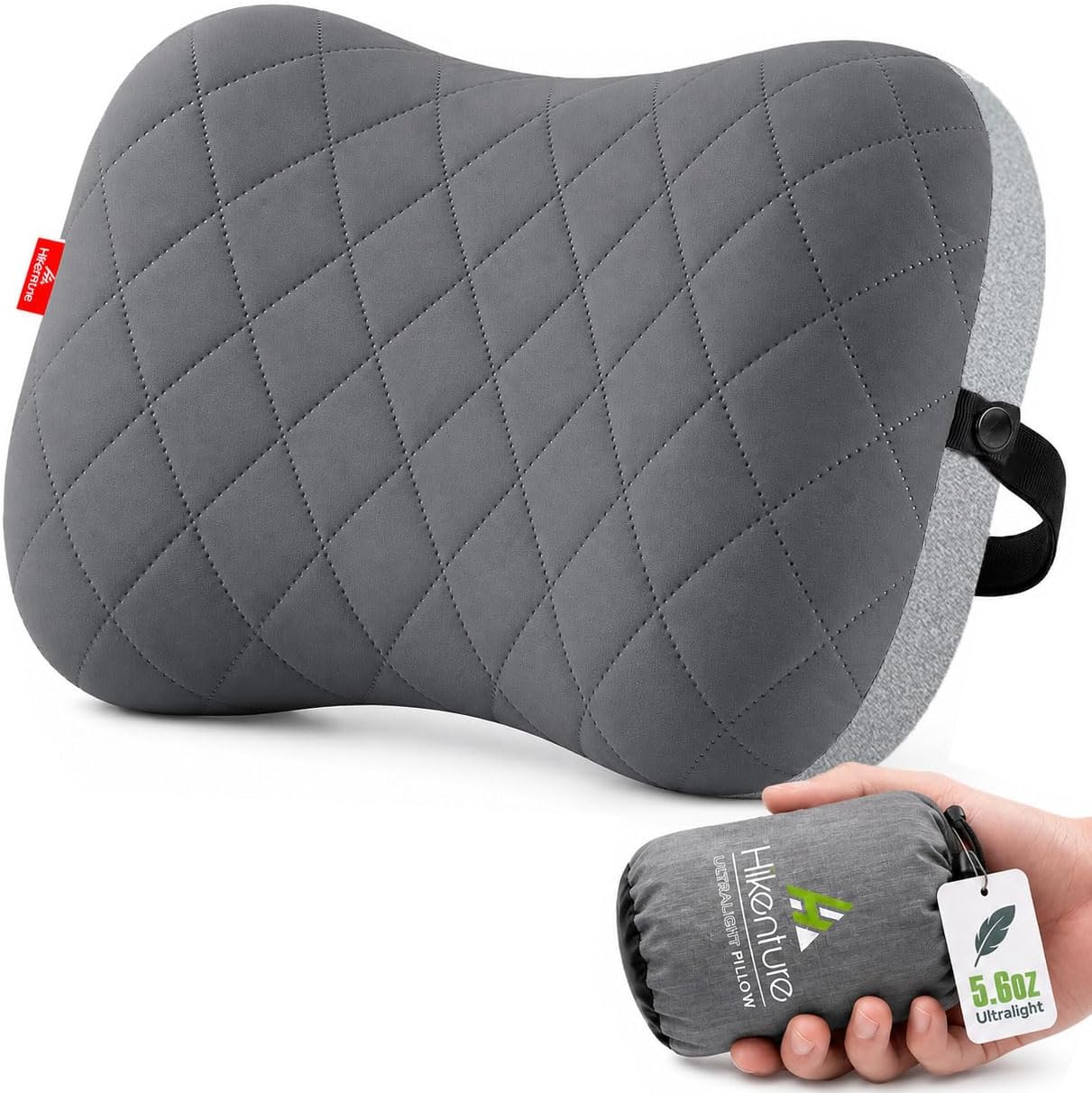
Choosing a camping pillow means deciding among three main styles: inflatable, compressible, and hybrid. The right choice depends on your sleeping position, how small the pillow needs to pack, how much noise bothers you, and whether you prefer a firmer or softer feel. Use this guide to compare your options and find a pillow you will actually want to sleep on.
The short answer
If you want the smallest packed size, pick an inflatable pillow. If you want the most familiar, comfortable surface and have room to carry it, pick a compressible pillow. If you want a compromise between size and comfort, choose a hybrid pillow that pairs an air chamber with a soft upper layer. For many campers, the best pillow is the one that adapts to their sleep position. Side sleepers usually need more loft, while back sleepers often prefer a lower profile. Keep those tendencies in mind as you compare styles, and you can also browse our selection of camping pillows later to see what is available.
How each option works
Inflatable pillows
An inflatable pillow is essentially an air chamber with a valve. You blow it up, or use a compatible pump if the manufacturer offers one, and you deflate it when you are done. Because it stores flat, it takes up very little space. The main trade-offs are the potential for a leak, the noise of the material, and the fact that you need to tune the air pressure to match how you sleep. You can usually adjust firmness by adding or releasing air, which helps with side and back sleeping. For a wide range of designs, look for inflatable camping pillows with a brushed fabric cover if you want less crinkling.
Many inflatable pillows have a soft cover or a textured surface that reduces noise. Look for a reliable valve and keep a patch kit nearby if you camp in rough terrain. If you need to repair a small leak, the same approach for air sleeping pads generally applies. You can follow the steps in our guide to find and patch a leak in an air sleeping pad.
Compressible pillows
A compressible pillow is filled with synthetic fill or foam that squishes down into a stuff sack. When you release it, the fill expands like a regular pillow. It does not pack as small as an inflatable, but it usually feels softer and more familiar. Compressible pillows are quiet and give you a forgiving surface to rest your head. These are a practical choice for car camping, hammock camping, or any setup where you have room.
If you like to sleep on your side, a compressible pillow with a higher loft can help fill the gap between your neck and shoulder. For back sleepers, a lower loft is often more comfortable. Check the manufacturer’s instructions for washing, since some compressible pillows are spot-clean only.
Hybrid pillows
A hybrid pillow combines an air core with a layer of padding or foam on top. You still get the compact packing advantage of an air chamber, but the padded surface feels closer to a traditional pillow. Hybrid designs can also reduce the crinkle sound that some inflatable pillows make. Because of the extra materials, a hybrid pillow tends to weigh a bit more than a simple inflatable and takes up slightly more space.
The payoff is a more comfortable pillow for many campers. If you often camp in a tent but occasionally use a camp cot, a hybrid pillow can work for both setups. For more on choosing a cot that pairs well with your sleep setup, look at our camping cot guide.
Side-by-side comparison
This table summarizes the key differences among the three camping pillow types.
| Consideration | Inflatable | Compressible | Hybrid |
|---|---|---|---|
| Packed size | Smallest | Largest | Medium |
| Comfort | Adjustable firmness | Soft and plush | Soft top with air core |
| Noise | Can crinkle | Quiet | Usually quieter than inflatable |
| Weight | Lightest | Heavier | Between the two |
| Durability | Vulnerable to punctures | Durable fill may compress | More parts to manage |
| Best for | Backpackers and minimalists | Car campers who want home comfort | Campers wanting a balance |
Once you choose a pillow, think about how it pairs with your sleeping pad and sleeping bag. For more help on building the rest of your sleep setup, visit our sleeping gear guide.
Which pillow is best for your sleeping position?
Side sleepers
Side sleepers need a pillow that fills the space between the ear and shoulder. If the pillow is too thin, your neck tilts down. If it is too thick, your neck tilts up. Inflatable pillows work because you can add more air to reach a taller height. Compressible pillows can also work if they have enough loft, but they may sink over the course of the night. Hybrid pillows give you a useful combination of height and softness, especially if the padding sits on top of an inflated core.
Before buying, test the pillow by pressing on it the way you would in bed. A common rule of thumb is to aim for a height that keeps your neck in a fairly straight line from your spine. If you are between two styles, choose the more adjustable option.
Back sleepers
Back sleepers usually need a flatter pillow. A thick pillow pushes the head forward and can make your neck feel strained. Look for a pillow that sits lower and supports the natural curve of the neck. A lightly inflated inflatable pillow or a low-loft compressible pillow often works well. Many back sleepers also appreciate a soft, breathable surface, and a compressible pillow can provide that without much loft.
Stomach sleepers
Stomach sleepers generally need the thinnest pillow, or none at all. If that applies to you, look for an inflatable pillow you can barely inflate or a compressible pillow with a very low profile. The goal is to avoid turning your neck too far to the side.
Packed size, noise, and staying on your sleeping pad
Packed size
Packed size matters more for backpackers than car campers. If you are carrying your own gear, an inflatable pillow is hard to beat. Compressible pillows can take up as much room as a small blanket. Hybrid pillows fall in between and give you a good balance when you have limited space but still want extra comfort. Check the spec sheet to compare packed dimensions, because pillow shapes vary and you want to know whether one will fit in your pack.
Noise
Some inflatable pillows make a crinkling sound when you move. The noise depends on the outer fabric, the internal structure, and how much air is inside. A pillow with a fleece or brushed cover is generally quieter. Compressible pillows are quiet because the fill absorbs movement. Hybrid pillows use padding to reduce the sound, though the air chamber can still be audible if you shift quickly. If you are a light sleeper, choose a pillow with a fabric cover and a valve that does not sit under your ear.
Sliding off your sleeping pad
Several things can make a pillow slip: the pillow slides on the pad, the pad itself is smooth, or the pillow does not stay put when you turn. Look for a camping pillow with a textured bottom, a non-slip patch, or a built-in strap that wraps around the sleeping pad. If your pillow has none of these, place a camp towel or a piece of microfiber cloth underneath to add grip. You can also tuck the pillow against the shoulder area of your sleeping bag, but a dedicated strap is the most reliable solution. Check the manufacturer’s instructions for attaching any straps so you do not damage the valve or fabric.
Cleaning and long-term care
Inflatable pillow care
Wipe the outside with a soft cloth and mild soapy water. Do not submerge an inflatable pillow in water, because liquid can get into the valve and affect its ability to hold air. Dry the pillow fully before storing it. To avoid punctures, clear sharp objects from the area under your sleeping pad, and do not sit on the pillow or place heavy gear on top of it. If your pillow develops a leak, repair the air bladder the same way you would an air pad. For a thorough walkthrough, see our article on finding and patching a leak in an air sleeping pad.
Compressible pillow care
Many compressible pillows are not machine washable. Check the tags and the manufacturer’s instructions before cleaning. Many can be spot-cleaned with a mild detergent and then air dried. For pillows with a removable cover, wash the cover according to the label and hand-clean the inner fill. Store a compressible pillow loosely rather than compressed, because keeping it stuffed for a long time can flatten the fill and reduce support.
Hybrid pillow care
Because hybrid pillows combine materials, follow the care instructions for the most delicate part. Some have a removable washable cover. Clean the air chamber the same way you would an inflatable pillow, and avoid machine washing unless the manufacturer approves it. Regularly inspect the seams and valve area during camp setup. Hybrid pillows have more components, so early wear is easier to catch before it becomes a problem.
FAQ
Can I use a regular bed pillow while camping?
Yes, but it will take up a lot of space and can collect moisture. A camping pillow is designed to compress, resist moisture, and weigh less. If you are car camping with extra room, a regular pillow can work, but you will need to dry it out during the day.
How much should I inflate an inflatable camping pillow?
Start with a low amount of air and test the pillow. Add air a little at a time until your neck feels aligned. Many campers prefer to over-inflate slightly and then let out a bit of air for a softer feel. The ideal pressure depends on your sleep position and the shape of the pillow.
How do I stop my camping pillow from sliding around?
Use a pillow with a strap, a non-slip underside, or place a towel or dry bag under the pillow. Some sleeping pads have a textured surface that helps, but the simplest fix is adding a layer of cloth between the pillow and the pad.
Are hybrid pillows worth the extra weight?
If you dislike the feel of a pure inflatable pillow but need a smaller packed size than a compressible one, a hybrid is worth considering. The extra weight is modest compared to the comfort you gain. Compare the manufacturer’s weight and packed dimensions to make sure it fits your camping style.
A camping pillow may be small, but it can make a big difference in how you feel the next morning. Match the pillow to your sleeping position and camp setup, keep it clean, and store it properly. With the right choice, you will look forward to bedtime on your next trip.