Some links on this page are affiliate links. If you buy through them, we may earn a commission at no extra cost to you. As an Amazon Associate I earn from qualifying purchases. Learn more ›
Best Camping Compasses
Compare camping compass listings by specs such as luminous dials, waterproof ratings, lensatic designs, inclinometers and warranty terms. Check each listing for details.
This post contains Amazon affiliate links. As an Amazon Associate I earn from qualifying purchases, at no extra cost to you.
Choosing among the best camping compasses comes down to a few practical questions: whether the needle and dial are easy to read in low light, whether the body is built to handle rough outdoor use, and whether the compass includes features such as a sighting lens, a tripod mount or an inclinometer. This article compares ten compasses on those points.
The picks were chosen by comparing listing specifications and features, not by hands-on testing. We have not carried or used these compasses in the field. Check each listing for current price, availability and full details before you buy, because specifications and included accessories can change.
The Sportneer Orienteering Compass is a lightweight metal compass with a rear sight lens, a waterproof and shock-resistant build, and glow-in-the-dark markings for low-light navigation. It suits hikers, campers, scouts, and beginners who want a durable, dependable compass with a strap and pouch included.
Pros & Cons
Pros
Solid metal construction feels durable and built to last through years of outdoor use
Rear sight lens and clear dial make taking bearings straightforward, even for beginners
Glow-in-the-dark markings are useful for night hikes and low-light conditions
Affordable price point with strap and carrying case included
Highly rated by a large base of customers, reflecting consistent satisfaction
Cons
At 7.2 ounces, it is heavier than plastic alternatives and may feel bulky for young children around the neck
The glow feature requires prior exposure to light and fades after use in darkness
Accuracy depends on holding the compass level, so the needle needs time to settle for readings
Detailed Review
The Sportneer Orienteering Compass is a metal baseplate compass designed for hikers, campers, hunters, scouts, and families looking for a dependable navigation tool. It targets outdoor users who want straightforward, no-nonsense orienteering without the complexity of advanced instruments.
The rear sight lens is the highlight, magnifying the dial so bearings can be taken quickly and with confidence. The needle settles reliably when the compass is held level, and the glow-in-the-dark coating on the north indicator and markings helps with navigation after dark once it has been charged by light.
Build quality is a clear strength. The metal base and cover give the compass a sturdy, substantial feel, and the waterproof and shockproof claims suggest it can handle rain, drops, and rough trail conditions. At 7.2 ounces, it is noticeably heavier than plastic options, which is worth considering for long pack-ins or young children wearing it on a lanyard.
The main drawbacks are the weight and the glow feature, which depends on prior light exposure and fades over a night of use. Users also need to keep the compass level for accurate readings, a basic skill that takes a little practice to master.
Overall, the Sportneer compass offers strong value for its price, combining durable construction, a helpful rear sight, and useful night visibility with a strap and pouch included. It is a reliable choice for beginners, kids, and seasoned hikers who want a sturdy backup or everyday trail compass.
This 4-pack of plastic orienteering compasses includes a rotating bezel, built-in metric ruler, and magnifier for map reading and navigation on hikes or camping trips. It suits budget-minded hikers, scouts, and group leaders who need backup compasses for multiple people.
Pros & Cons
Pros
Excellent value, with four compasses in a single purchase
Practical map tools, including a ruler, scale, and magnifier, are useful for orienteering
Lightweight and easy to carry on day hikes, camping, and backpacking trips
Lanyard included for quick access and secure carrying
Cons
Plastic body is less rugged than metal or premium compasses and may not withstand heavy abuse
Small size (about 4.1 x 2.4 inches) can make the markings harder to read for some users
Accuracy and feature quality are basic compared with professional-grade navigation instruments
Detailed Review
The RLXMARTD 4 Pcs Outdoor Compass is a multi-pack of basic orienteering compasses designed for hikers, campers, scouts, and outdoor educators. Each unit features a rotating bezel, a needle for directional reference, and a built-in metric ruler for measuring distances on maps.
In day-to-day use, the rotating bezel and magnifier make it simple to plot a bearing and read small map details. The adjustable declination feature lets you account for magnetic variation in your area, which is useful when you move between regions. The ruler and distance scale add practical value for route planning.
The compass body is made of plastic, which keeps the weight low at roughly 0.21 kg for the item. The build feels suited to light to moderate outdoor use, though it lacks the durability of metal housings. The small footprint of about 4.1 by 2.4 inches makes it easy to pocket, but the markings are compact and may take some getting used to.
The main drawback is the plastic construction, which may not hold up to rough handling or long-term heavy use. Users looking for precision for technical expeditions may want a higher-end instrument. The needle and bezel are functional but basic.
Overall, this four-pack offers strong value for families, scout troops, classrooms, and anyone who wants spare compasses in a bug-out bag or vehicle kit. It is an affordable, practical choice for learning map reading and basic navigation, and it is best suited to recreational and training use.
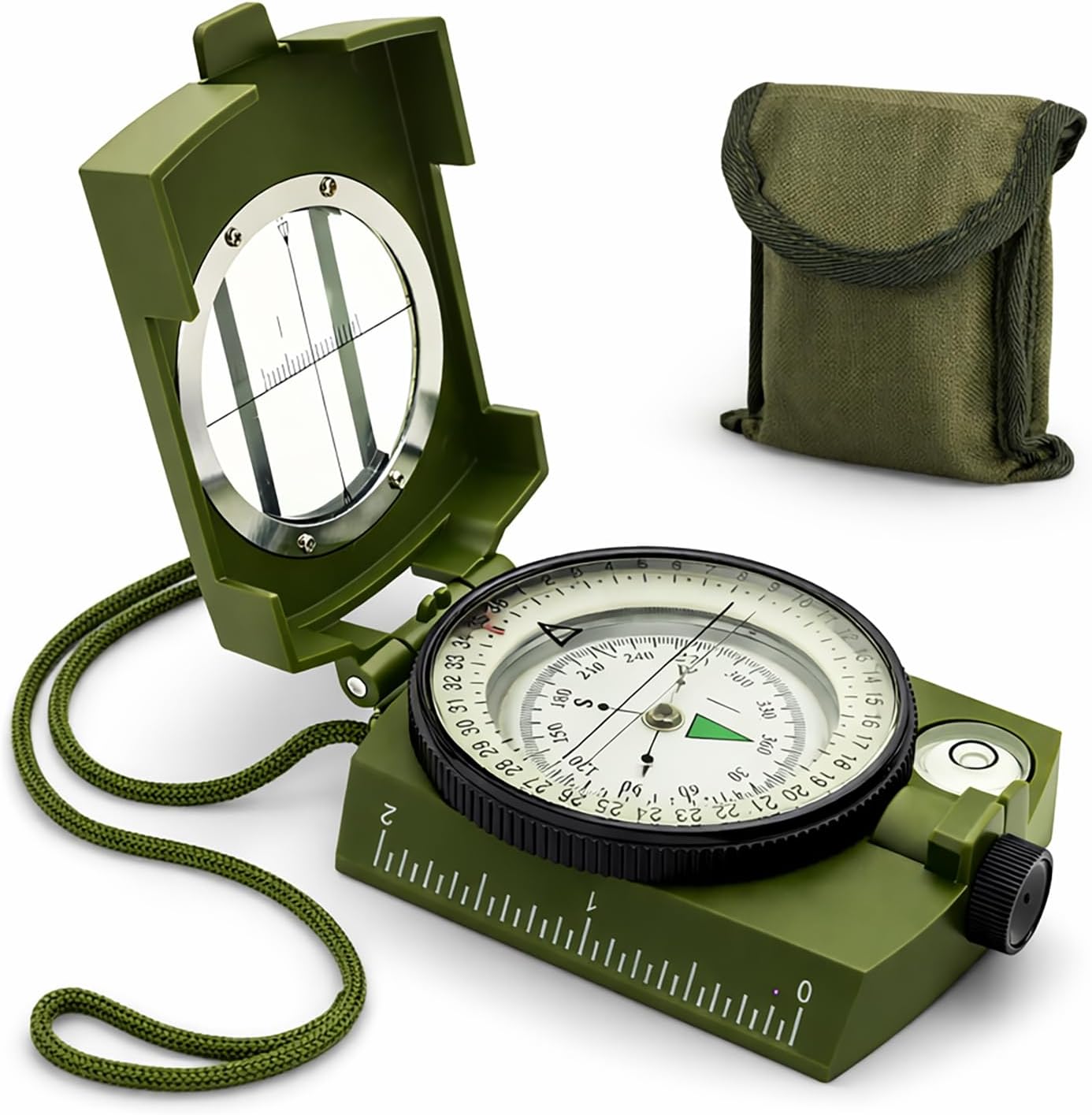
The COTOUXKER HL240 is a pocket-sized aluminum lensatic compass with a prism lens, bubble level, and glow-in-the-dark markings. It suits hikers, campers, and survival kit builders who want an affordable, water-resistant backup navigation tool.
Pros & Cons
Pros
Lensatic design and prism lens offer more accurate readings than basic compasses
Glow-in-the-dark interface makes it practical for night hikes and emergencies
Aluminum body feels durable and resists water for trail and camping use
Affordable price point makes it an easy addition to a survival kit
Cons
The aluminum body weighs 0.22 kg, which is heavier than slim plastic compasses
The lensatic design has a learning curve for beginners who are new to sighting bearings
The 91-day warranty is short compared with many outdoor gear brands
Detailed Review
The COTOUXKER HL240 is a lensatic hiking compass built for hikers, campers, mountaineers, and anyone who wants a dependable backup to GPS. Its pocket-sized frame makes it easy to carry on day hikes or stow in a survival kit without adding bulk.
The lensatic sighting system and prism lens make it easier to line up bearings and read the dial accurately. The built-in bubble level helps you keep the compass level, which reduces errors when plotting a route across unfamiliar terrain.
The aluminum body feels solid in hand and resists water well enough for rain, stream crossings, and damp camping conditions. The glow-in-the-dark dial and fluorescent markings are useful for reading headings at night, when a map and light source are harder to manage.
The main drawbacks are its weight, which is heavier than slim plastic alternatives, and the learning curve that comes with lensatic navigation. The 91-day warranty is also shorter than what some premium outdoor brands offer.
Overall, the HL240 offers strong navigation value for its price. It is a practical choice for beginners who want to learn map and compass skills, and for experienced hikers who need a reliable, budget-friendly backup tool.
Specifications
Brand: COTOUXKER
Model Number: HL240
Item Type: Compass, lensatic hiking and survival design
Material: Aluminum
Special Feature: Water-Resistant, glow-in-the-dark dial, bubble level, prism lens
Item Weight: 0.22 kg
Included Components: Compass with carrying case, lanyard, or pouch
The Eyeskey Military Sighting Navigation Compass is a liquid-filled, waterproof aluminum compass with a built-in clinometer, sighting hairline, and luminous dial for taking bearings and measuring slope angles. It suits hikers, campers, hunters, and backcountry skiers who want a rugged, navigation-focused compass with a three-year warranty.
Pros & Cons
Pros
Rugged aluminum construction that holds up to demanding outdoor use
Clear luminous dial and magnifier make readings fast, even in dim conditions
Versatile for both bearing navigation and slope or elevation measurement
Includes protective pouch, carrying box, and lanyard right out of the box
Strong customer rating across a large base of verified reviews
Cons
Compact size may feel small for users with larger hands or who prefer a bigger baseplate
Learning the sighting and clinometer functions takes some practice for beginners
Aluminum body is heavier than plastic alternatives at 175 g, which adds weight for ultralight packers
Detailed Review
The Eyeskey Military Sighting Navigation Compass is a heavy-duty, liquid-filled navigation tool designed for hikers, campers, hunters, scouts, and backcountry skiers. It combines traditional bearing navigation with a built-in clinometer, making it useful well beyond basic trail orientation.
The standout features are its luminous dial, adjustable luminous marching line, thumb hold, and magnifying viewer, which together make taking readings quick and clear. The sighting hairline and adjustable diopter lens let you align distant landmarks precisely, while the clinometer reads slope angle, elevation, and avalanche-prone terrain angles on steep ground.
Build quality is one of the product's strongest points. The waterproof aluminum alloy body feels solid and is designed to withstand rough handling, and the included canvas pouch, carrying box, and lanyard help protect it on the trail. A tripod mount adds versatility for mapping or survey-style work.
The compact footprint is a double-edged sword, as the baseplate is small and may be tight for users with larger hands. The aluminum housing also weighs 175 g, which is noticeably heavier than plastic options. Beginners should expect a short learning curve to master the sighting and clinometer functions.
Overall, this is a capable, rugged compass for anyone who needs reliable bearings and slope measurement in demanding environments. With a three-year warranty and a strong rating from a large number of users, it is a dependable choice for serious outdoor enthusiasts.
The AOFAR AF-4074 is a zinc die-cast lensatic military compass with a liquid-filled capsule, floating luminous dial, and built-in inclinometer for slope measurement. It suits hikers, campers, Boy Scouts, and geology or mapping users who want a rugged, waterproof compass with navigation and sighting features.
Pros & Cons
Pros
Rugged zinc die-cast build feels solid and resists the knocks of everyday outdoor use.
Liquid-damped dial stays stable and readable, which helps when walking or on uneven ground.
Luminous markings are useful for night navigation and low-light camping.
Inclinometer and gradienter add practical value for geology, surveying, and slope estimation beyond basic navigation.
Includes a carrying bag, lanyard, and manual, so it is ready to use out of the box.
Cons
The lensatic sighting design and extra features have a learning curve for beginners who only need a basic direction compass.
Compact size with a small dial may be harder to read quickly for users with limited eyesight or in very dim conditions.
The listed item weight in the product data appears inconsistent with the compact size, so buyers should check the actual weight before purchase.
Detailed Review
The AOFAR AF-4074 is a lensatic military-style compass built for hikers, campers, scouts, and geology students who need more than a basic bearing tool. It combines a liquid-filled capsule and floating dial with sighting and slope-measuring features in a single pocket-sized instrument. It is a practical choice for anyone who wants a dependable compass that handles a wide range of field tasks.
In everyday use, the floating 360° dial settles quickly and stays readable when the compass is held at an angle or moved along a trail. The sighting line, magnifier, and prism lens make it easier to take precise bearings on distant landmarks. The built-in inclinometer and slope chart are especially useful for estimating grades on hills, cliffs, and rock formations.
The zinc die-cast body feels heavy-duty and well machined, and the waterproof, shakeproof construction suits rain, mud, and rough handling. The luminous dial and magnetic arrow add useful visibility for dawn starts and night navigation. The tripod connection is a welcome extra for surveying or mapping work where steady readings matter.
The main drawbacks are the learning curve for lensatic sighting and the small dial, which can be harder to read quickly in dim light or for users with weaker eyesight. Some buyers may find the feature set more than they need if they only want a simple direction finder. The listed item weight in the product data also looks inconsistent with the compact dimensions, so it is worth confirming before ordering.
Overall, the AOFAR AF-4074 offers strong value for its rugged build, versatile features, and included carrying accessories. It is well suited to outdoor enthusiasts, scouts, and students who want a multifunction military-style compass. Beginners who only need basic navigation may prefer a simpler model.
This is a compact, lanyard-mounted plastic orienteering compass with a liquid-filled magnetic needle, a 360-degree rotating bezel, and a 1:24000 map scale ruler for reading topographic maps. It suits beginners, Scouts, kids, and hikers who want an inexpensive, dependable backup navigation tool for trails, camps, and paddling trips.
Pros & Cons
Pros
Fast-settling liquid-filled needle provides a clear, reliable north reading.
Lightweight and compact, so it fits easily in a pocket, pack, or on a lanyard.
Magnifier and map scale ruler are useful for reading and measuring topographic maps.
Simple enough for children and beginners, yet capable enough for regular hikers.
Strong value for a basic navigation tool that many buyers use for years of outdoor activity.
Cons
Plastic construction is lightweight but less durable than metal or higher-end baseplate compasses under heavy use.
The product listing contains repetitive, keyword-heavy text and a few typos, so buyers should rely on the specifications rather than the marketing copy.
Basic features mean it lacks declination adjustment tools, sighting mirrors, or other advanced functions needed for serious surveying or technical navigation.
Detailed Review
The TurnOnSport Orienteering Compass is a small, classic baseplate compass built for hikers, campers, Scouts, and beginners learning land navigation. It combines a liquid-filled magnetic needle, a 360-degree rotating bezel, and a 1:24000 map scale ruler in a package that is easy to carry and simple to understand.
In everyday use, the liquid-filled needle settles quickly, so you can take a reading without waiting for it to stop swinging. The orienteering lines and bezel make it straightforward to set a bearing and follow it across open ground, while the magnifier helps when reading dense topographic map details.
The acrylic baseplate and plastic housing feel light and practical rather than premium. The nylon lanyard keeps the compass attached to a backpack, zipper pull, or wrist, which is helpful for younger users who tend to misplace gear.
The main drawbacks are the plastic build, which can wear or scratch with rough handling, and the limited feature set, which leaves out advanced tools such as sighting mirrors and declination adjustments. Buyers expecting professional surveying performance should look at higher-end models.
Overall, this is a reliable, affordable compass for recreational navigation, scouting, and emergency backup. It delivers the essentials well, and it is an easy recommendation for anyone who wants a dependable first compass or a simple survival gift.
The YKFLEXT lensatic compass is a foldable plastic pocket compass with a glow-in-the-dark dial, adjustable declination, and built-in bubble level, sold with a pouch and lanyard. It suits hikers, campers, and emergency kit builders who want a low-cost, lightweight backup navigation tool.
Pros & Cons
Pros
Very affordable entry point for a lensatic compass with a complete accessory set
Luminous markings are practical for low-light navigation
Lightweight and compact enough to carry at all times
Declination adjustment and bubble level add useful precision for the price
Cons
Plastic housing feels less robust than all-metal compasses and may not withstand heavy abuse
Lensatic sighting style has a learning curve for users who are new to map and compass work
Water resistance is not the same as full waterproofing, so submersion should be avoided
Detailed Review
The YKFLEXT lensatic compass is a budget-friendly, foldable navigation tool built for hikers, campers, hunters, and anyone who wants a dependable backup compass in an emergency kit. It comes with a carrying pouch and lanyard, so it is ready to use straight out of the package.
Its standout feature is the glow-in-the-dark dial, which makes night bearings far easier than on most basic pocket compasses. The adjustable declination screw lets you compensate for local magnetic variation, and the built-in bubble level helps you keep the compass flat for more consistent readings on uneven terrain.
The build is mostly plastic with a glass lens and a foldable protective lid. It is light and compact, which suits daily carry, though the plastic housing does not feel as rugged as metal lensatic models that cost considerably more.
The main drawbacks are the plastic construction and the learning curve that comes with lensatic sighting, so beginners may want to practice in a safe area before relying on it. Water resistance is also not a substitute for waterproofing, so keep it out of standing water.
Overall, this is a sensible, low-cost compass for casual hiking, camping, and emergency kits, especially for buyers who value the night-reading dial and bubble level. Serious backcountry users who need a tougher instrument should look at all-metal lensatic options instead.
The Anbte ABT024 is a bronze metal lensatic compass with a sighting window, a luminous magnet arrow, a built-in inclinometer, and a 1-degree minimum reading. It suits campers, hunters, and hikers who want a rugged, sight-based compass with a 2-year warranty.
Pros & Cons
Pros
Rugged metal construction handles rough outdoor use and harsh weather
Luminous markings are useful for low-light and nighttime navigation
Inclinometer and scale add functionality beyond basic direction finding
Ships with pouch, lanyard, and multi-language manual, ready to carry out of the box
Cons
At 278g, it is heavier than basic plastic compasses, which matters for ultralight backpackers
The glow effect depends on adequate sunlight exposure beforehand, so it may be dim after cloudy days or indoor storage
Its lensatic design takes practice to use well, so beginners may need time to learn sighting and bearing techniques
Detailed Review
The Anbte ABT024 is a lensatic hiking compass built for campers, hunters, hikers, and anyone who wants a dependable navigation tool beyond a simple baseplate compass. Its sighting window and line let you take precise bearings on distant landmarks, which makes it a practical choice for off-trail travel.
Standout features include a luminous magnet arrow and compass card that glow after charging in sunlight, a built-in inclinometer with a side scale for measuring slopes and heights, and a floating dial with a 360 degree scale and 1-degree minimum graduations. The bubble level helps keep readings level, which supports consistent accuracy in real conditions.
The body is made from zinc alloy with a bronze finish and a foldable metal lid, giving it a solid, military-style feel. The manufacturer rates it as waterproof and shockproof, with an operating range from -20°C to 50°C. At 278g, it is noticeably heavier than plastic alternatives, but that weight reflects its sturdy build.
The main drawbacks are the weight and the learning curve of a lensatic design, which is less intuitive than a thumb-style compass for beginners. The glow feature also relies on sunlight charging, so it will not perform well without prior exposure. Buyers who need an ultralight option may prefer a smaller model.
Overall, the Anbte ABT024 offers strong value for its rating and feature set. It is well suited to experienced outdoor users and anyone who wants a rugged compass with a built-in inclinometer and a 2-year warranty.
The SUUNTO A-30 is a compact, battery-free baseplate compass built around a high-grade steel needle on a jewel bearing, with luminous markings for low-light navigation. It suits hikers, orienteering beginners, and skiers or trail runners who want a dependable, lightweight backup navigation tool.
Pros & Cons
Pros
Accurate, fast-settling needle on a jewel bearing for dependable headings
Luminous markings provide usable visibility in low light conditions
Magnifying lens and transparent baseplate simplify map work
Compact, lightweight, and battery-free for everyday carry
Consistent build quality from an established Finnish compass maker
Cons
Declination is fixed and balanced for northern hemisphere use, so it is not suited to southern hemisphere navigation
Made of plastic, which is lightweight but less rugged than metal-housed alternatives for extreme use
Lacks advanced features such as a sighting mirror or adjustable declination, so it is best for basic to intermediate navigation
Detailed Review
The SUUNTO A-30 is a compact baseplate compass designed for hikers, orienteers, and outdoor enthusiasts who want reliable direction finding without batteries. Its small size and light weight make it an easy addition to a daily pack or a ski jacket pocket.
The high-grade steel needle sits on a jewel bearing, which lets it settle quickly and swing freely for accurate bearings. The luminescent markings remain readable in low light, which is useful for early starts, dusk hikes, or dense forest cover. The magnifying lens on the transparent baseplate makes it straightforward to align the compass with a paper map.
Built from plastic, the A-30 feels light and practical rather than premium, and it is designed to be washed and kept clean in rough conditions. Its metric scales and fixed declination are calibrated for northern hemisphere use, so users in other regions should look elsewhere. Advanced navigators may also miss a sighting mirror or adjustable declination.
For its price class, the A-30 delivers dependable, battery-free navigation backed by strong customer ratings and Suunto's long heritage in navigation instruments. It is an excellent choice for beginners, recreational hikers, and anyone who wants a trustworthy backup compass in their kit.
The Jewheg Hiking Compass is a pocket-sized aluminum survival compass with a lensatic sighting eyepiece, bubble level, dual 360-degree scales, and glow-in-the-dark markings. It suits hikers, campers, and climbers who want a rugged, lanyard-ready backup navigation tool at a budget-friendly size.
Pros & Cons
Pros
Lensatic sighting design makes taking precise bearings easier than basic baseplate compasses
Glow-in-the-dark features provide clear readings in low light and darkness
Solid aluminum construction feels durable for hiking, climbing, and field use
Lanyard mount and compact size make it easy to carry on every outing
Affordable price point for a dependable backup navigation tool
Cons
Glow-in-the-dark effect fades after exposure to light, so it may need recharging with a flashlight before dark use
Not a substitute for formal navigation training, and users should learn to use a map and compass together
Lensatic compasses have a learning curve, so beginners may need practice to achieve accurate bearings
Detailed Review
The Jewheg Hiking Compass is a compact lensatic survival compass built for hikers, campers, climbers, and anyone who wants a dependable backup to their phone's GPS. It packs a sighting eyepiece, a bubble level, and clearly marked scales into a body small enough to fit in a jacket pocket.
Its standout feature is the optical eyepiece, which lets you line up distant landmarks and read bearings precisely. The dual 360-degree and reversed scales make it easy to plot a route or trace your way back to camp, and the glow-in-the-dark markings help you read the dial in dim light or total darkness.
Build quality is a highlight, with a metal base and cover that feel sturdy in hand and handle the bumps of a daily pack. The lanyard mount keeps the compass within reach on a zipper pull or strap, so it is less likely to get lost on the trail.
The main drawbacks are the fading glow, which requires a light source to recharge, and the learning curve that comes with lensatic compasses. Beginners should practice in a safe area before relying on it in the backcountry, and the compass works best when paired with a topographic map.
Overall, the Jewheg Hiking Compass offers strong value for its size, durability, and low-light usability. It is a smart choice for outdoor enthusiasts who want a rugged, affordable navigation tool to keep in their kit.
Camping Compass Buying Guide
Lensatic, Baseplate and Military-Style Designs
Compasses in this roundup fall into a few common styles. A baseplate compass has a flat, transparent base that works well with paper maps, and many include a magnifying lens for reading small map details. A lensatic compass has a folding sighting lid and a viewing window, which the listings describe as helping with taking bearings on distant objects. Military-style compasses are often sold as lensatic models with extra features such as a bubble level or a clinometer.
Among the lensatic listings, COTOUXKER lensatic compass and YKFLEXT lensatic compass both describe a folding lid and a prism or lens design. The listing for Jewheg survival compass also describes a lensatic function, a prism lens and a bubble level. If you are new to navigation, a baseplate model may be easier to match against a map. If you plan to take bearings on distant landmarks, the sighting features in the lensatic listings are the ones to compare. For a basic introduction to map work, see How to Use a Map and Compass for Camping and Hiking.
Luminous Markings and Low-Light Reading
Many listings in this group mention glow-in-the-dark or luminous features. These are usually applied to the needle, north indicator or dial markings, and the listings say they need exposure to light before they glow. Check the wording in each listing, since the description of how bright the glow is, or how long it lasts, is not always given.
The listing for Sportneer metal compass says the north indicator and dial markings use a fluorescent coating. The Eyeskey military compass with inclinometer lists a luminous dial and an adjustable luminous marching line. AOFAR AF-4074 military compass describes a luminous magnet arrow and dial. The listing for SUUNTO A-30 compass mentions luminescent markings for low-light use. For night use, the listings suggest exposing the compass to light before you need it, which is a practical habit regardless of model.
Water resistance is described differently across the listings. Some call a model waterproof, others water-resistant, and some only use the term in the title. The water resistance wording in the listing is the detail to compare, not a general assumption. Where a listing does not state a material or water-resistance level, it is best to confirm with the manufacturer before relying on that feature in wet conditions. For weather planning, see Camping Weather Safety: Storms, Lightning, Heat and Cold.
Declination is the difference between magnetic north and true north. The YKFLEXT lensatic compass listing describes an adjustable declination screw. The RLXMARTD four-pack plastic compass title also refers to adjustable declination. The SUUNTO A-30 compass listing describes a fixed declination, and says the baseplate is balanced for northern hemisphere use. If you navigate in a location where declination matters, compare how each listing handles it and read the manufacturer’s manual for setup steps.
Warranty, Included Accessories and Map Reading Tools
Included accessories also differ. Several listings include a pouch and lanyard. The TurnOnSport orienteering compass listing describes a rotating bezel, a magnifying glass and a map ruler scale. Map reading features matter most if you plan to use paper maps alongside the compass. For emergency planning that goes beyond navigation, see Camping Emergency Gear Checklist.
The listing for SUUNTO A-30 compass states that no batteries are required. Most compasses in this roundup are mechanical, but confirm the details on each listing.
What does a luminous dial do?
A luminous dial or marking is intended to help you read the compass in low light. Listings say these features need exposure to light first, so they may not glow well straight away.
Is a lensatic compass easier for beginners?
That depends on the user. Lensatic designs add sighting features that some people find useful for taking bearings, while baseplate designs are often matched against paper maps. Learning either style takes practice, and the manufacturer’s instructions are a good starting point.
A complete winter camping gear checklist for car campers. Learn what changes in your shelter, sleep system, clothing, kitchen, and safety kit when temperatures drop below freezing.
A complete checklist of camping gear for a car campsite trip, grouped by category with essentials and nice-to-have items, plus tips for weather and group size.
Learn to navigate with a map and compass: understand your compass, read a topographic map, take bearings, account for declination, and practice safely.
Compare the best foldable camping chair with canopy options by shade coverage, weight limit, packed size and setup time to find the right fit for your trips.
Compare the best mac sports double camping chair options for two. See key specs, pros, cons and how to pick the right seat for your campsite and needs.
Compare the best inflatable chair for camping by comfort, weight, packed size and load rating. Find the right pick for car camping, backpacking or long stays.
Learn what separates a high end camping chair from a standard one, including frame materials, weight capacity, seat height and packed size, so you buy with conf
Looking for a high chair camping chair? Compare 8 tall camp chairs by seat height, weight capacity and packed size to find the right fit for your camp.